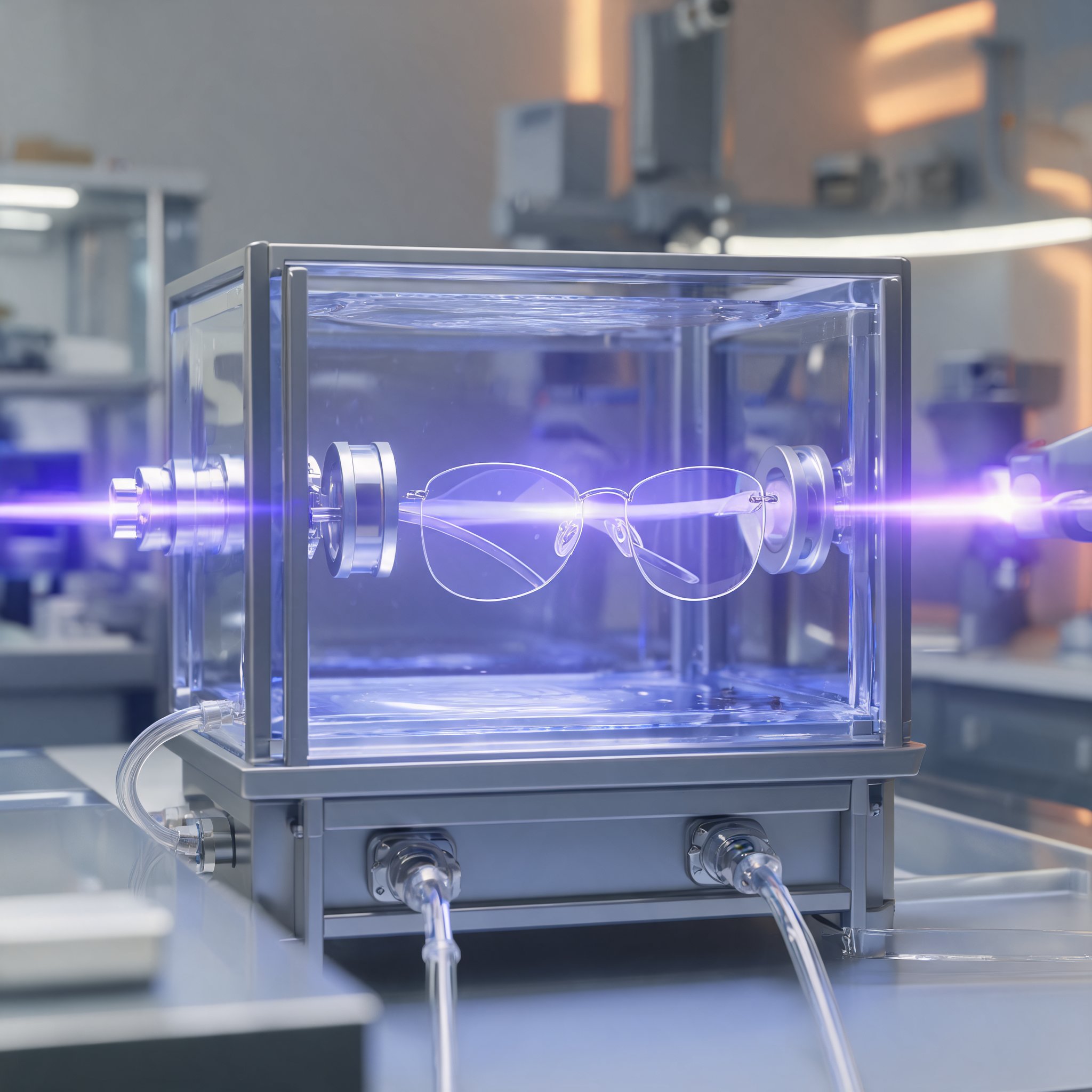
Spanish ophthalmic technology company IOT says it is the first to 3D print personalized progressive lenses, using a process that forms the complete lens with a single flash of light in a few seconds. The company says lenses made with its Light-Form technology are already on sale to consumers. The method does not build lenses layer by layer and skips the generating and polishing stages used in conventional lens surfacing.
IOT frames the development as a production method for prescription optics, not a demonstration. It says a new process for personalized progressive lenses must reproduce the intended optical design precisely, rather than merely produce a recognizable shape. According to the company, Light-Form combines the design freedom of digital manufacturing with those optical requirements, allowing additive manufacturing to make prescription lenses at commercial optical quality. The company also says the approach could support new lens architectures and more individualized designs.
How the forming step works
Light-Form is based on stabilized frontal photopolymerization. A single pass of light cures the whole volume of the lens, instead of shaping it gradually from a blank; IOT says this forming stage takes seconds. Finishing steps follow before the lens is complete: unused resin is recovered to reduce waste, the lens surface is hardened, and the lens is mapped. IOT's resource comparison with conventional production covers the manufacturing stage only. Within that boundary, the company reports no water use in manufacturing, 90% less energy and 76% less waste.
José Alonso, co-founder and CINO of IOT, said the technology shows how scientific research can change the way ophthalmic lenses are made. He added that combining optical precision with a new production method could help optical partners create personalized products, test new lens architectures and run more flexible manufacturing.
A different production footprint
IOT presents Light-Form as a way to reorganize lens production, not just accelerate one step. Larger installations could use several printing heads to raise output without taking up much floor space. Further ahead, the company envisions compact machines making custom lenses inside optical stores, placing production closer to the customer and reducing the need to hold stock.
Carolina Gago, IOT's COO, said the value lies in rethinking the production workflow. Resin recovery and lower water and energy requirements address resource use, she said, while compact equipment could support production nearer to consumers. IOT says it is working to turn these capabilities into practical manufacturing options.
For optical laboratories, the model could mean organizing capacity around local demand instead of depending only on centralized surfacing equipment. For wearers, IOT says the long-term benefit would be faster access to lenses made for them. The company adds that optical partners would remain central to vision correction and customer service.
Beyond conventional spectacles
IOT is also developing options beyond ordinary eyewear. One option under development is printing prescription optics directly onto waveguides and flat substrates used in smart glasses and augmented reality headsets, which could make those devices thinner and lighter. The company suggests custom optical shapes could eventually be useful in virtual reality as well.
The company is not alone in applying additive manufacturing to vision correction. Luxexcel was an early example in prescription eyewear, building lenses layer by layer in a material jetting process after conventional production had relied on roughly 30 steps, large inventories and high wastage. Its platform could print single-vision, freeform and multifocal progressive lenses, and it embedded waveguides into prescription lenses for smart glasses. Meta later acquired Luxexcel as part of its AR technology work.
More recently, a University of Waterloo team developed a system that 3D prints custom contact lenses in about 20 minutes, raising the prospect that a patient could be measured, have a lens designed and leave a clinic wearing it after one visit. The work received a Gold Medal at the Shanghai International Exhibition of Inventions in June 2026. IOT says its Light-Form personalized progressive lenses are already reaching consumers, while its broader production and smart-glasses concepts remain at earlier stages.